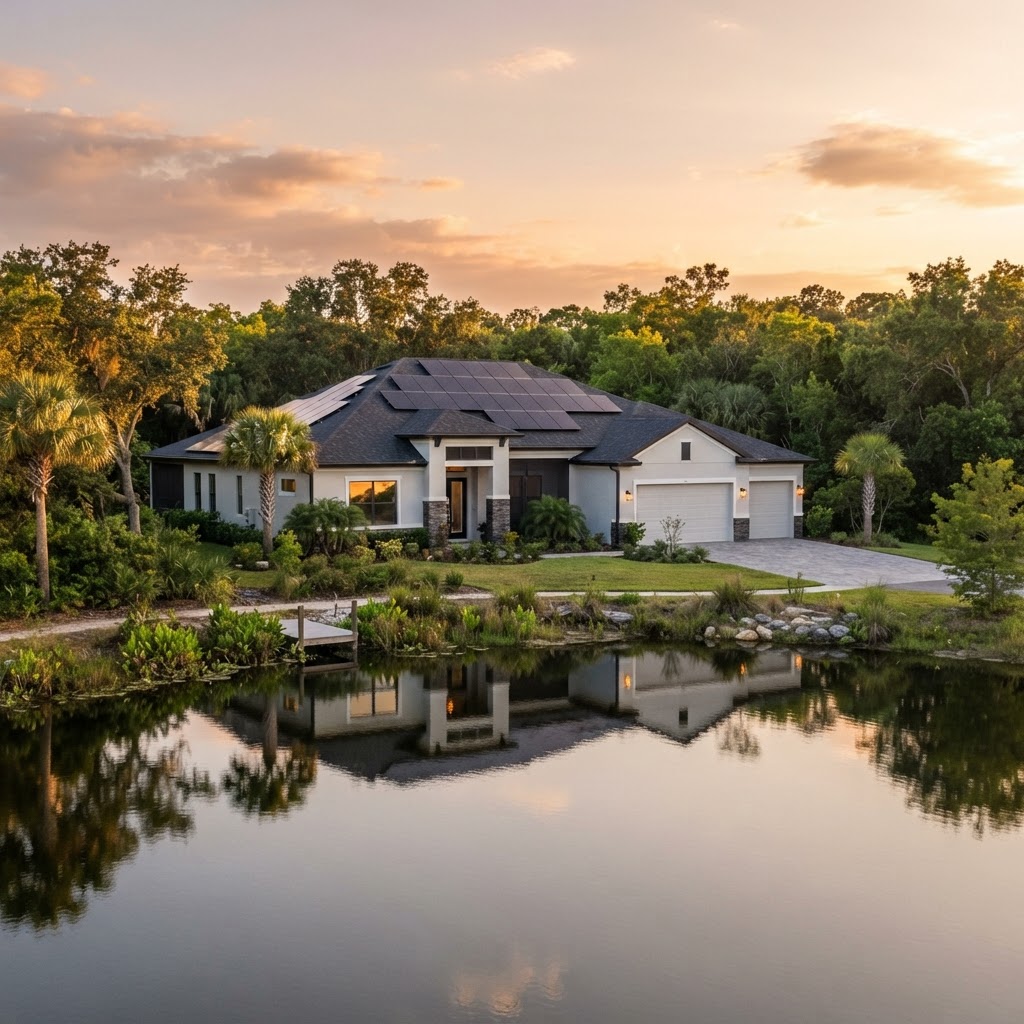
Florida research puts the resale premium for an owned rooftop solar system at $15,000-$30,000 (3-5%). Here's the honest math from a 40-panel owned system on a real Ruskin home — taxes, insurance, and the buyer's alternative of adding panels later.
The Short Answer
Yes — and more than most Florida buyers expect. Research from Lawrence Berkeley National Laboratory and Zillow puts the resale premium for an owned rooftop solar system at roughly $15,000 to $30,000, or about 3 to 5 percent of the home's sale price. Those numbers come from actual sales, not projections, and they hold up best in sunny markets like Tampa Bay where the panels do real work. The catch, and it matters more than everything else in this article: the premium belongs to owned systems. Leased systems can subtract value instead of adding it.
We live this math every month. Our home — Sunset Haven, a five-bedroom, 3,232-square-foot pond-view house in the gated Mira Lago community in Ruskin, on the South Shore of Tampa Bay — carries a 40-panel, roughly 16-kilowatt system that we own outright. Here is the honest breakdown of what that means for value, taxes, insurance, and a buyer's alternatives.
What the Research Actually Says About Solar and Home Value
Three findings repeat across the serious studies:
- The premium is real but modest relative to cost. Zillow's analysis found solar homes sold for around 4 percent more than comparable non-solar homes. Berkeley Lab's work on transaction data landed in the same neighborhood.
- It is priced per watt. Buyer premiums cluster around $3 to $5 per installed watt, which is why bigger owned systems carry bigger premiums — a 16 kW array sits at the high end of what a house can hold.
- Sellers rarely recoup their full original cost. Installation prices fall every year and panels depreciate, so a buyer purchasing a system that is already installed, permitted, and producing captures most of the remaining value. That is why buying an existing solar home is usually a better deal than adding panels after the fact.
Owned vs. Leased: The Detail That Decides Everything
When a system is leased or under a power purchase agreement, the buyer either assumes the remaining payments or the seller has to buy out the contract at closing. Both paths complicate financing and negotiations, and appraisers treat leased panels as a liability rather than an asset. When the system is owned, the panels pass with the title like any other fixture — no contract, no assumption, no friction at the closing table. Our system is owned, which means it transfers to the buyer clean at no additional cost.
What 40 Panels Actually Covers on a Florida Home
Forty modern panels at roughly 400 watts each add up to about a 16-kilowatt array — larger than the vast majority of residential systems. In central Florida, a system that size can offset most or all of a home's annual electric use, including the air-conditioning load that runs hard from May through October. Actual output depends on roof orientation, shading, and seasonal cloud cover, so any serious buyer should ask for the system's monitoring data and verify production history rather than trusting nameplate numbers. We can provide that.
Do Solar Panels Increase Property Taxes in Florida?
No — and this surprises people. Florida law (Section 193.624, Florida Statutes) exempts renewable energy source devices, including rooftop solar, from property tax assessment. The panels raise the home's market value without inflating the tax bill the way a new pool or addition would. Homeowners insurance is the one place to do homework: panels installed to current hurricane wind-load codes are accepted by most carriers, though some apply a separate deductible or want an inspection. Ask your carrier for a written quote before you close.
The Buyer's Math: This House vs. Adding Panels Later
Say you skip a solar home and buy a comparable non-solar house in Ruskin, Apollo Beach, or Sun City Center, then add your own 16-kilowatt system. At current installed prices of roughly $2.50 to $3.50 per watt, that new array costs somewhere around $40,000 to $56,000 before incentives. The federal tax credit takes a bite out of that, but you still pay for design, permitting, interconnection paperwork, and months of scheduling — and you take the risk on roof condition and HOA approval.
Buying a home with a large owned system already in place removes all of that. The panels are producing the day you get the keys, the permitting and interconnection are years behind you, and the premium you pay for them at closing is well below what the same system costs to build today.
Solar Home Buyer FAQ
Do solar panels increase property taxes in Florida?
No. Florida Statute 193.624 exempts rooftop solar from ad valorem assessment. Confirm current treatment with your county property appraiser, but the law is clear.
What happens to solar panels when you sell a house?
An owned system transfers with the property automatically. A leased system must be paid off by the seller or assumed by the buyer, which is why owned systems sell more smoothly.
Is it better to buy a house that already has solar?
Usually, yes — if the system is owned. You inherit a producing asset at a discount to today's installation cost, with no permitting or construction risk.
How do Florida insurers treat rooftop solar?
Most carriers accept panels that meet current wind-load standards. A few add a deductible or require an inspection, so get a written quote during your option period.
Can the system be expanded later?
It depends on remaining roof space, inverter capacity, and utility interconnection rules. A post-purchase site assessment settles it.
Want to see what a 40-panel, owned-system home looks like in person? Sunset Haven is a five-bedroom, three-bath pond-view home in Mira Lago, Ruskin, Florida, offered at $550,000. View the Zillow listing here: https://www.zillow.com/homedetails/408-19th-St-NW-Ruskin-FL-33570/463863222_zpid/